Product playbook for founders
Building the product people stay in

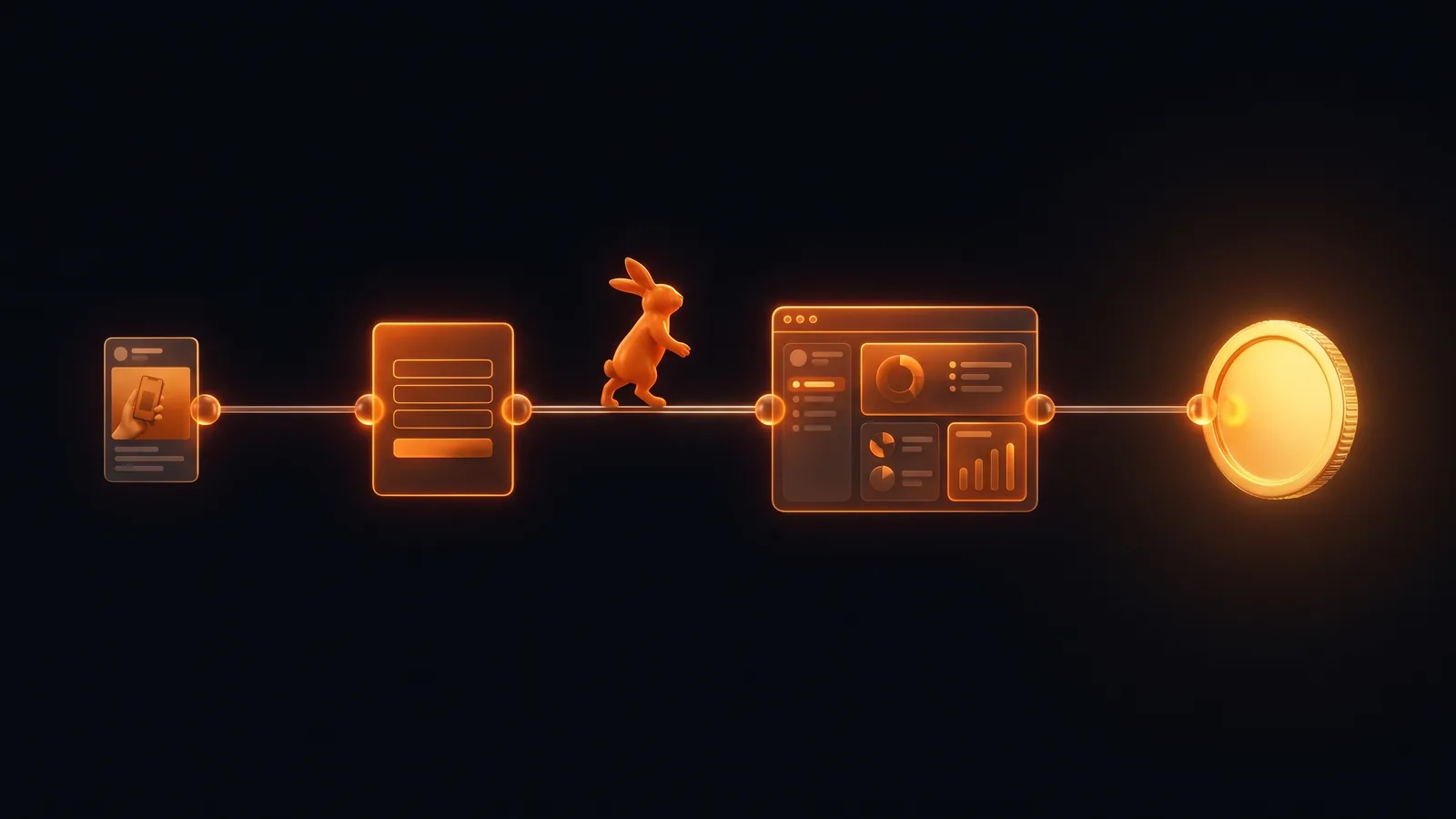
A go-to-market partner can bring people to your product. Your product team makes them stay. To give every new user the best chance of activating, coming back and paying, decide five things before you build, design the shortest path to one first win, ship small every week without breaking that path, track one funnel from first ad to paying customer, and add budget only after payback holds.
Who owns what
Everything up to the moment a lead is inside your product
Ads and outbound (people discover you), a landing page per buyer, signup (a lead becomes an account) and the front door (the same promise as the ad). Nurture emails that bring users back and up are run on this side too.
Everything inside
Strategy, design, build, data, retention and pricing. The first win, activation on one leading feature, is shared. Return visits, paid plans and upgrades are yours.
1. Strategy: decide before you build
The best product teams write down five answers before they write code, and revisit them every month. A missing answer is the first piece of work, not a detail for later.
The five answers
- The buyer. Who exactly pays, and what just happened that makes them look for a fix now? One role, one trigger, in their own words.
- The problem. The painful job they do today, and what they do it with. One sentence a buyer would repeat back to you.
- The leading feature. The one feature that delivers the first win, such as "send your first quote" or "run your first shift".
- The activation event. The one tracked event that proves the first win happened, agreed with your go-to-market partner before launch.
- The business model. How revenue grows as a customer gets more value: a pricing unit tied to usage or outcomes, never to effort.
Build the smallest product that delivers the leading feature well
Everything else waits until real users ask for it. A focused product is easier to explain in an ad, to onboard and to measure.
Keep a "not now" list
Every good idea that is not the leading feature goes on it. Saying no is how a small team ships fast.
Turn the roadmap into bets
Each item states the user problem, the metric it should move and how you will know. Features with no metric are a wish list.
Let distribution inform the product
Ads and outbound show which angles and promises get people to sign up. The message that wins in the ad is often the clearest statement of what the product should do first.
2. Design: the shortest path to the first win
Design the first session before anything else, because it decides whether a new signup becomes a user. Every screen between signup and the leading feature has to earn its place.
Pick up where the ad left off
The first screen uses the same words and shows the same outcome as the ad and landing page, so users know they are in the right place.
Cut, defer, prefill
Remove every step the first win does not need. Move profile, settings and invites to later. Prefill with sample data or templates so value shows before work.
Make empty states teach
An empty screen says what to do next and offers one button that does it.
One primary action per screen
Three equal buttons make the user think. Make the next step obvious.
Design the return trip
Decide what brings a user back on day two: a result waiting, a reminder with real value, or work a teammate left. Share it with whoever writes your nurture emails.
Watch the first session weekly
Session recordings show where people hesitate or leave. Fix those moments first.
- Start every piece of work with a one-page brief: the user, the problem, the metric.
- Sketch the flow in low fidelity first and walk it with real users from your target buyer.
- Use one design system with shared components so the product feels consistent and ships faster.
- Check accessibility and mobile on every screen, not at the end.
3. Development: ship small, ship weekly, never break the first win
Speed matters more than elegance early on, but the path from signup to activation is protected at all times.
Choose boring, proven tools
Managed hosting, a mainstream framework, hosted auth and payments. Teams building in Lovable or a similar tool can move very fast; keep the leading feature and tracking clean so you can rebuild later without losing data.
Ship in small slices
Small changes merged often, released behind feature flags so you can switch something off without a redeploy. Release at least weekly.
Protect the critical path
Automated tests cover signup, the leading feature, the activation event and payment. If one fails, nothing ships.
Watch production
Error alerts, uptime checks and page speed on signup and the first session. A broken first session wastes every paid user sent that day.
Respect data and privacy
Ask for consent where the law requires it, store only what you need and limit access to customer data.
Definition of done, for every feature
- It works on desktop and mobile
- Its tracking events fire with the right properties and are checked in the analytics tool
- Tests cover anything that touches the critical path
- It sits behind a flag or can be rolled back
- The team knows which metric it should move and when you will read it
4. Tracking: one funnel, one source of truth
Write the tracking plan before you build and agree it with your go-to-market partner. The marketing half of the funnel and the product half must join into one line from first ad to paying customer, or nobody can say what a paying customer costs.
Name events the same way everywhere
Object then action, past tense: signup_completed, project_created. One shared plan lists every event, its properties and its owner.
Pass the source through
Store the campaign, channel and angle from ads and outbound (UTM parameters) on every user at signup, so both teams can read retention by channel.
| Event | What it proves | Owner |
|---|---|---|
| landing_viewed, signup_started | Someone arrived and showed intent | Go-to-market partner |
| signup_completed | A lead became an account | Go-to-market partner |
| onboarding_step_completed | Where people stall in the first session | Shared |
| activated | The first win happened on the leading feature. The number both teams chase | Shared |
| key_action_repeated | The user came back and got value again | Product team |
| subscription_started, plan_upgraded | The user paid, then paid more | Product team |
| subscription_cancelled | Why people leave, with a reason attached | Product team |
- Review metrics in this order: activation rate, time from signup to first win, retention by weekly cohort, conversion to paid, then cost per paying customer against the payback line.
- Read cohorts, not totals. Group users by signup week and channel and plot how many stay active each week after. A curve that flattens means people found lasting value. A curve that keeps falling means the product leaks, and more traffic will not fix it.
- Tools: a product analytics tool such as Amplitude, Mixpanel or PostHog, session recordings for the first session, and a live funnel dashboard. Check every new event appears there before you call it done.
5. Retention: earn the second visit, then the habit
Marketing can make signups cheaper. Only the product can make them stay, and a user who stays is what makes every ad pay back.
Fix activation first
If people never reach the first win, no reminder or discount will hold them. Most retention problems are activation problems in disguise.
Build a reason to return
Strong products get more useful with use: saved work, history, a team that collaborates, results that arrive after the user leaves. Pick one and design for it.
Talk to users every week
Short calls with newly activated users, power users and people who left. Ask what they tried to do, what nearly stopped them and what they would miss. Their words often become the next ad.
Price for retention
Charge for the unit that grows with value, offer annual plans to active users and make upgrades obvious in the product.
Learn from every exit
Ask one question at cancellation, read the answers weekly and feed the top reason into next week's bet. Then tell past users what changed.
Run one retention bet a week: one change, one hypothesis, one metric, one cohort. Write the result down next week, whether it moved or not.
6. Launch: prove it small, then add fuel
Launch is a sequence of gates, not a day. Go live in about two weeks on a deliberately small budget, and let spend grow only when the numbers say the product holds the users it gets.
- Before launchLaunch checklist done
Build v1
The leading feature and the tracking plan.
- About two weeksFunnel all green
Go live small
Small budget, read the first cohorts, fix the biggest leak.
- By month 3Payback holds
Prove the funnel
Know what a paying customer costs, and which angle and channel carry it.
- By month 6
Add fuel
Three months of your own numbers to put more budget behind.
Before the first paid user arrives
- The leading feature works end to end on desktop and mobile
- The activation event fires and shows in the shared dashboard
- Source and campaign data is stored on every new user
- The onboarding front door matches the ad: same promise, same words, one path to the first win
- Signup, login and payment are tested and monitored, with alerts
- The events your nurture emails need are live: signed up, not activated, activated, trial ending
- There is a support channel and someone answering it
- User calls are booked for the first week
Product optimisation follows the funnel. Once every step up to the product hits its line, deeper product work becomes the priority, because only then can its effect be read cleanly.
7. Weekly rhythm: one week, two teams
Two teams work as one when they look at the same numbers on a fixed rhythm.
| When | Meeting | Who and what comes out |
|---|---|---|
| Monday | Funnel and cohort review | Product lead and go-to-market partner. Out: the biggest leak this week and who owns it. |
| Tuesday | Weekly growth update | What ran, what it cost, what we learned on ads and outbound. |
| Midweek | User calls | Product team, partner invited. Notes shared, new ad angles found. |
| Friday | Ship and write up the bet | Product team. The result, and next week's bet. |
| Monthly | Payback and roadmap review | Founder, product lead and partner. Budget decision, updated bets and the "not now" list. |
When something breaks, say so the same day
A broken signup or first session costs both teams money. A shared channel with one named contact on each side is enough.
Keep one written record
The tracking plan, the leading feature, the activation event and every bet result live in one shared place, so a new teammate can catch up fast.
Frequently asked questions
What should a startup decide before building its product?
Five answers: the buyer and the trigger that makes them look for a fix now, the problem in one sentence a buyer would repeat, the one leading feature that delivers the first win, the activation event that proves it happened, and a business model where revenue grows with the value the customer gets.
What is a tracking plan?
A shared document that lists every product and marketing event, its properties and its owner, named the same way everywhere (object then action, past tense). It joins the marketing funnel and the product funnel into one line from first ad to paying customer.
What should be ready before a startup turns on paid acquisition?
The leading feature working end to end on desktop and mobile, the activation event firing in a shared dashboard, source and campaign data stored on every user, a front door that matches the ad, monitored signup and payment, nurture email events, a staffed support channel and user calls booked for week one.
How long before a startup knows what a paying customer costs?
A common sequence is to go live in about two weeks on a small budget, fix the biggest leaks from the first cohorts, and know by around month 3 what a paying customer costs and which angle and channel carry it. Timelines vary by product, audience, offer and budget.
Keep reading

What products that keep their customers do differently
The retention practices behind products that last: value in the first session, one core job, a reason to return, weekly listening and retention before spend.

We bring you the customers. Your product makes them stay.
How a startup and its go-to-market partner split the customer journey: who owns ads to signup, who owns activation and retention, and when spend goes up.
The examples here are common industry practice, not Big Shorter Media results. Results vary by product, audience, offer and budget. Nothing on this page promises a specific result.